Few people recognize that a body shape category isn’t simply a visual label—it emerges from precise classification built on specific measurements that a body shape calculator, functioning as a data-driven tool, uses to classify your physique with methodical accuracy. By inputting your body measurements—bust, waist, hips, and high hip—the calculator converts raw numbers into ratios that reveal how your circumferences relate across key zones, cross-referencing your individual profile against standard body shape categories such as hourglass, pear, apple, rectangle, spoon, and inverted triangle. Years of working alongside clients on body awareness have consistently confirmed one thing: the data rarely matches the body type they assumed they had.
✨ Body Shape Calculator
Enter your measurements below to discover your unique body shape
and get personalised style recommendations
📏 How to Measure Correctly
-
📐 Your Measurements
❤ Waist-to-Hip Health Indicator
Key Characteristics
✅ Embrace & Highlight
❌ Avoid & Minimise
👕 Tops
👖 Bottoms
👗 Dresses & Skirts
🧳 Outerwear
These well-known personalities share a similar body shape. Remember: shape is just one characteristic — every body is unique and beautiful!
The estimate this tool delivers isn’t a permanent identity—it’s a diagnostic frame that turns raw physique data into something actionable. Once you understand where your bust and hips land on the spectrum, whether your waist leans hourglass or tilts toward apple, your ratios stop being abstract figures and start driving real decisions. The classification process works precisely because it bypasses subjective perception, anchoring every result in measured circumferences and giving each individual a consistent body shape category drawn from real body measurements. What follows—from targeted health advice to more intentional fashion recommendations—only carries weight when built on honest data and accurately mapped standard body shape categories.
What Is a Body Shape Calculator?
A body shape calculator is a fast, free, online tool designed to classify and determine your figure based on key physical measurements — primarily bust, hip circumference, high hip, and shoulder measurements recorded in either inches or centimeters. You simply input these measurements, hit calculate, and receive an instant result that maps your silhouette to one of seven recognized body types: hourglass, pear, apple, rectangle, spoon, or inverted triangle. Unlike a glance in the mirror or a superficial appearance scan, it uses actual proportions to give women and men a reliable read on their body type — no eyeballing, no foolproof formula assumptions, just data.
What separates a good body shape calculator from a purely aesthetic exercise is the range of value it delivers beyond clothing and style preferences. Your shape reflects your genetic makeup, fat mass, and fat distribution — making it a legitimate indicator of health rather than a verdict on attractiveness loaded with negative connotations. A waist-hip ratio embedded in the results can quietly surface health risks that a standard weight check misses entirely. For females especially, this kind of interactive reflection connects your body types data to targeted outfit ideas and outfits curated for every occasion, while illuminating how dietary choices, exercise routines, and healthy lifestyle habits visually register on your frame — ultimately leaving you more comfortable and confident in the body you are actually living in.
How to Find Your Body Shape?
Most people assume that knowing your body shape is just about looking in the mirror — but your silhouette can be genuinely deceptive without actual physical measurements to back it up. Grab a soft measuring tape and take four measurements strategically: your bust at its fullest part, your waist at its narrowest point (typically 3–4 inches below waist level), your hips, and optionally, your shoulder width as an optional measurement for greater precision. From there, head to a calculator, select your gender and preferred unit — whether that’s inches or centimeters (cm) — and make sure you enter everything in the same unit for an accurate result. Simply input data into each measurement field, and the tool will instantly compare your proportions against standard body shape rules to reveal your most likely body shape.
What most guides overlook entirely is what happens after you receive results — and frankly, that’s where the process gets genuinely useful. Once you determine your shape using metric units or imperial units, the door opens to explore recommendations built specifically around your frame: personalized health advice, fitness advice, and fashion advice all converging in one place. A high waist-to-hip ratio or elevated BMI — formally the body mass index — can surface real health risk patterns worth raising with your care team, particularly when medical issues are already part of the picture. Acting on these shape-specific insights meaningfully supports your long-term well-being in ways no generic chart can replicate. Whether the result points to a triangle, a classic hourglass, or something entirely different, it all begins with one deliberate decision: gather measurements — and when done right, it permanently shifts how you understand your own body.
How to Measure Your Body?
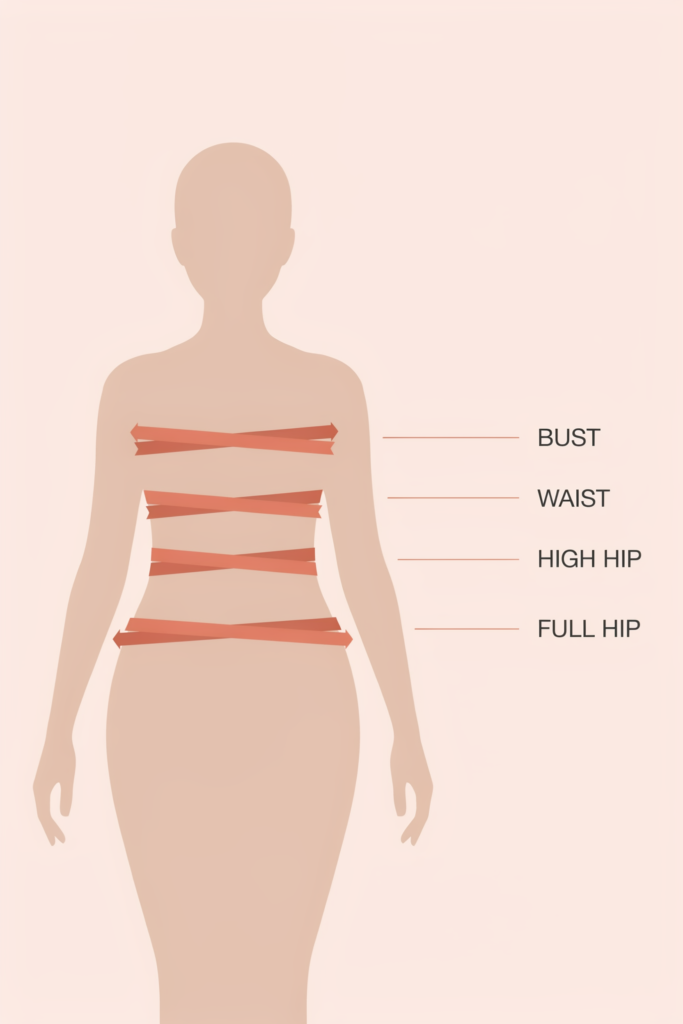
Nobody discusses this enough: where you position the tape matters far more than the tape itself. I’ve seen waist measurement placed at the navel, at the narrowest visible indent, and at the hip bone’s top edge — three positions, three completely different body shape outcomes. The skeletal frame holds its structure regardless, but placement drifts without guidance. Begin at the hip region at its absolute widest horizontal point, capturing the fullest curve across the thighs and buttocks, then record in either imperial inches or metric centimeters without switching systems mid-session. The upper body measurement at its fullest point comes next, and for those accounting for broad shoulders, the optional shoulder measurement delivers the lateral breadth that separates an athletic build from a straight body shape classification under the algorithm — across all 7 categories, this single input shifts outcomes more than users anticipate. The narrow frame zone between torso and hip becomes especially decisive for men, where weight distribution concentrating toward the abdomen pushes categorization in unexpected directions. A ruler cannot replace a flexible tape here; measurement-based accuracy is the actual foundation of reliable results.
What most people miss is that no single reading determines your shape — proportion ratios do. Dividing your waist circumference by your hip circumference produces the WHR, or waist-hip ratio, a figure functioning simultaneously as a health indicator and as a structural anchor within body shape formulas embedded in most browser-based calculators. When bust and hips balanced readings register as nearly equal while the waist pulls meaningfully inward, a clearly defined waist result emerges — but when all three zones converge without that contrast, the fashion industry classifies it banana. These actual body measurements feed into a body shape measurement table that benchmarks body proportions across both women and men through a structured comparison framework, flagging fat distribution patterns without requiring registration. The better tools are private and free, deliver an instant result, and map each input against defined thresholds — the output tells you exactly where your figures land.
What Are the Body Shapes?
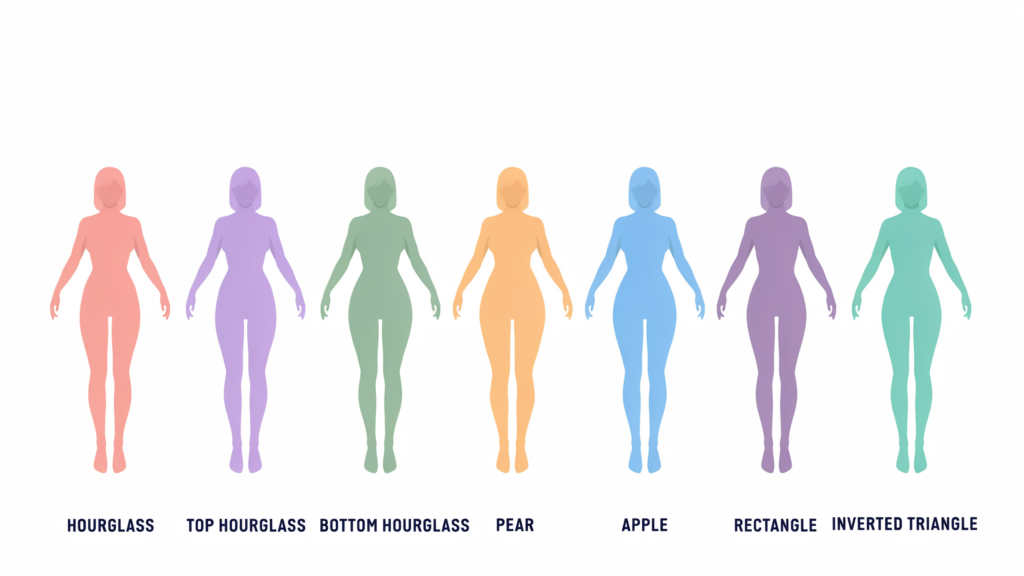
Most classification systems don’t begin with a mirror — they begin with measurements. The body shape formulas powering any reliable algorithm depend on precise circumference differentials: a gap of 2 inches holds one category while 3.6 inches shifts the outcome entirely, and thresholds of 7 inches, 9 inches, and 10 inches between bust, waist, and hip zones govern all 7 categories. A high hip to waist ratio of 1.193 is the exact dividing line between bottom hourglass and top hourglass — validated through the International Journal of Clothing Science and Technology, where a 1 inch differential also separates the triangle profile from closely adjacent shapes.
The fashion industry historically compressed this into just four body shape classes — banana, bell, X shape, and triangle — condensing body proportions into visual categories serviceable for pattern-making but insufficient for precision. The defining study from North Carolina State University in 2005, conducted across 6000 women, dismantled that framework: banana-shaped bodies represented 46% of participants, pear-shaped 20%, apple-shaped 14%, and hourglass-shaped only 8% — exposing the ideal X shape, formed by triangles opposing with hip measurements and waist measurements registering nearly equal within nine inches, as the statistical minority rather than the norm fashion had designed around for decades.
Once the seven body shape categories unfold across men and women, the distinctions become structural rather than stylistic. The hourglass body shape — the classic female body shape — presents proportions where bust and hips sit nearly equal, the waist running 25-30% smaller, producing balanced proportions and a defined waist that fashion long treated as its default. The pear body shape concentrates volume at hips thighs buttocks with hips noticeably wider than the shoulder line, demanding different natural proportions logic and clothing selection than the inverted triangle body shape — common in athletic women — where an upper body broader configuration and broader shoulders taper toward smallest hips.
The banana body shape runs minimal curves with a balanced silhouette and little waist definition, the straight read confirmed by waist measurements and hip measurements tracking closely together. The apple body shape concentrates fuller midsection mass with weight in midsection — a fat distribution pattern whose implications for cardiovascular risk factors and disease risk extend well beyond confidence and personal style, placing health assessment front and center. The spoon body shape — distinct for its pronounced high hip curve and hip shelf — places hips significantly larger than the torso, creating a lower body geometry distinct from the pear despite surface resemblance. For men, body shape guidelines span from a largest chest and smallest waist tapering down to hips profile to an oval or round reading where largest waist and weight around midsection dominate — a comparison the table format handles with more precision than any visual description alone
7 Body Shape Categories with Formulas:
While older systems worked with five body shapes, the seven body types framework — used by fashion stylists and clothing designers across male options and female options — resolves the gaps body shape classification rules expose. Every category starts with four measurements via soft measuring tape: bust size at the fullest part of breasts (using a non-padded bra, or at minimum a properly fitted bra), waist size at the smallest circumference near the belly button — the narrowest part of torso at 1 inch above navel — high hip size at the upper swell of hip (7–9 inches below natural waist, roughly 7 inches or 18 cm), and hip size at the largest circumference at the buttocks and pelvic bone. Remove clothing, stand straight and stand naturally, feet together, arms to side; keep the tape level and snug against the skin — tape snug means firm contact, not too tight — and never compress body tissue; breathe normally, take an accurate reading on the exhale, and inhale only after the tape is positioned; measure shoulders from tip of shoulder to tip of shoulder parallel to floor, confirm hip size at the widest part of hips and hip curve from a side view, and verify waist size at the natural waist for complete body shape measurements with accurate measurement. These measurements shift with age, puberty, pregnancy, menopause, and women aging — pre-pubescent bodies show minimal body shape change before estrogen and hormones differentiate the frame. The seat measurement (at the buttocks) and the pelvic region reading complete the picture for lower-body-dominant shapes.
1. Hourglass
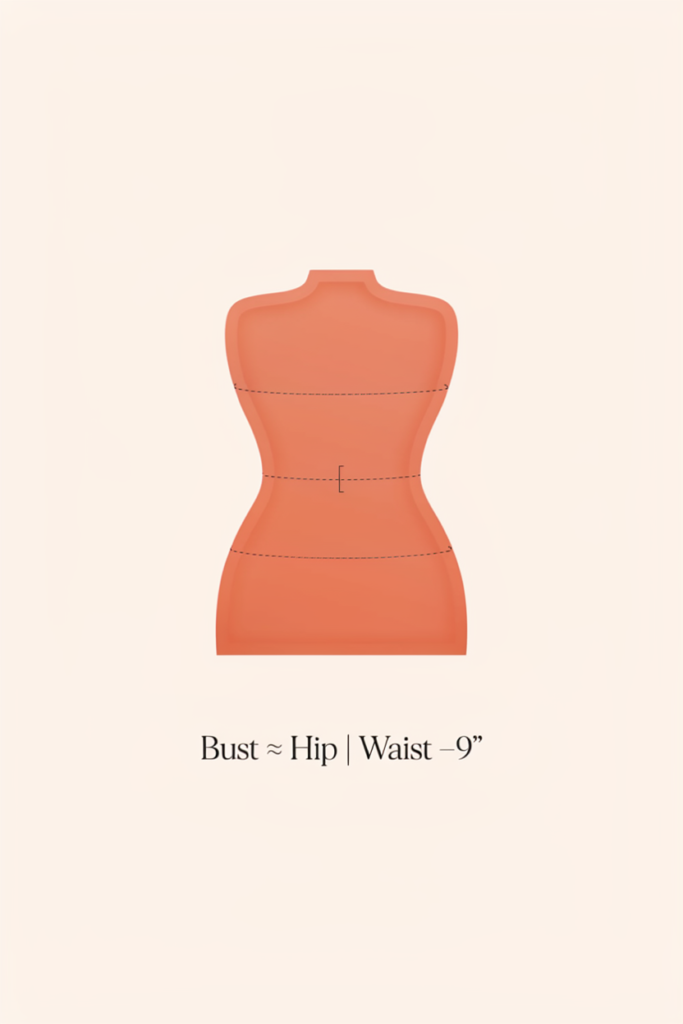
The classic shape benchmark starts with a precise ratio calculation: hips equal to bust size within 1 inch, narrower waist that is significantly smaller — the natural waist at its narrowest part of torso at least 9 inches below both. A waist-to-hip ratio of 0.70–0.79 is the formula; NIDDK (National Institute of Diabetes Digestive and Kidney Diseases) and the World Health Organization (WHO) link this natural shape to peak female attractiveness, optimal fertility, pregnancy rates, and strong cognitive ability — with the lowest risk factors for health conditions, health complications, and cardiovascular disease of any body shape. Proportions defined symmetrically across all zones produce a well-balanced, harmonious, proportional silhouette; accentuate curves, highlight the natural form — the fashion goal is simply to stay balanced.
Formula: |Bust − Hip| ≤ 1″, Waist ≤ Bust − 9″, WHR 0.70–0.79
2. Top Hourglass
The top hourglass registers when bust visibly larger than hips by 1 to 3.5 inches with a defined waist intact — a fuller chest and larger bust against a lower half that reads as slim upper body below the waistline. The chest and shoulders dominate the frame; from a side view, the balanced bust-to-hip ratio tilts upward, making the silhouette harmonious but structurally asymmetric. Clothing recommendations add volume below the waist to restore proportionate symmetry; outfit ideas center on straighter silhouette correction at the hip to balance the overall body shape.
Formula: Bust > Hip by 1–3.5″, Waist ≤ Bust − 7″
3. Bottom Hourglass
Bust smaller than hips by 1 to 3.5 inches, subtle waist still present — the bottom hourglass is identified by the shelf-like appearance at the hip curve and pelvic bone junction. The seat measurement at largest circumference at the buttocks exceeds bust size by a moderate margin; wide hips and wider thighs carry more peripheral fat than in the top hourglass, and this body shape is the most common configuration for women in premenopausal stages. Style tips prioritize restoring balanced bust-to-hip ratio upward through structured upper-body styling; the overall silhouette reads well-balanced despite lower-body dominance.
Formula: Hip > Bust by 1–3.5″, Waist ≤ Hip − 7″, WHR 0.70–0.80
4. Pear / Triangle Body Shape
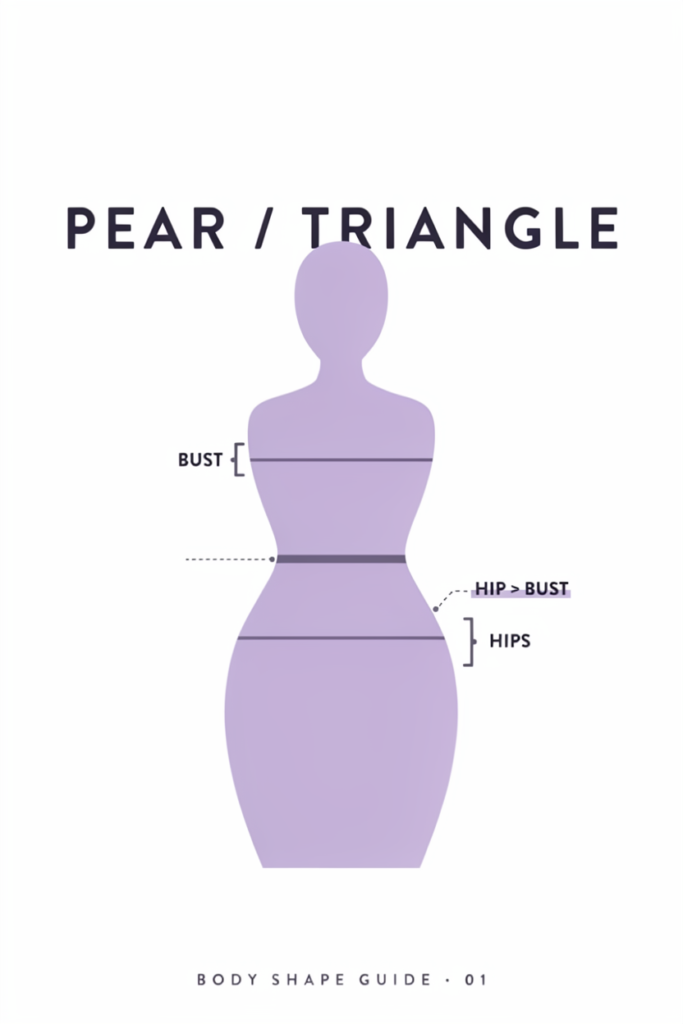
The triangle body shape — pear-shaped — crosses classification when the hip-to-bust gap exceeds 3.6 inches, with narrower shoulders, slim upper body, largest hips, and wider hips defining wider lower body against a narrower hip line at the bust; this triangle shape is among the most estrogen-influenced configurations in the seven body types. Estrogen drives it: hips widen and breasts develop through puberty as hormones push fat storage toward the pelvic region and hip curve; estrogen levels rise during pregnancy, while decreased estrogen levels at menopause cause fat redistribution back toward the midsection — a body shape change across women aging tied to post-menopausal bone structure shifts. The hip-waist ratio exceeds 0.80 for women (with 0.8 as the WHO clinical boundary) and 0.9 for men; adipose tissue concentration here is peripheral fat, carrying lower risk factors for cardiovascular disease than apple-shaped counterparts, per WHO and NIDDK data. Streamline lower half, balance proportions, and narrower hip line correction are the foundational fashion guidance and styling moves.
Formula: Hip > Bust by 3.6″+, Waist < Hip, WHR > 0.80 (women) / > 0.9 (men)
5. Apple / Round Body Shape
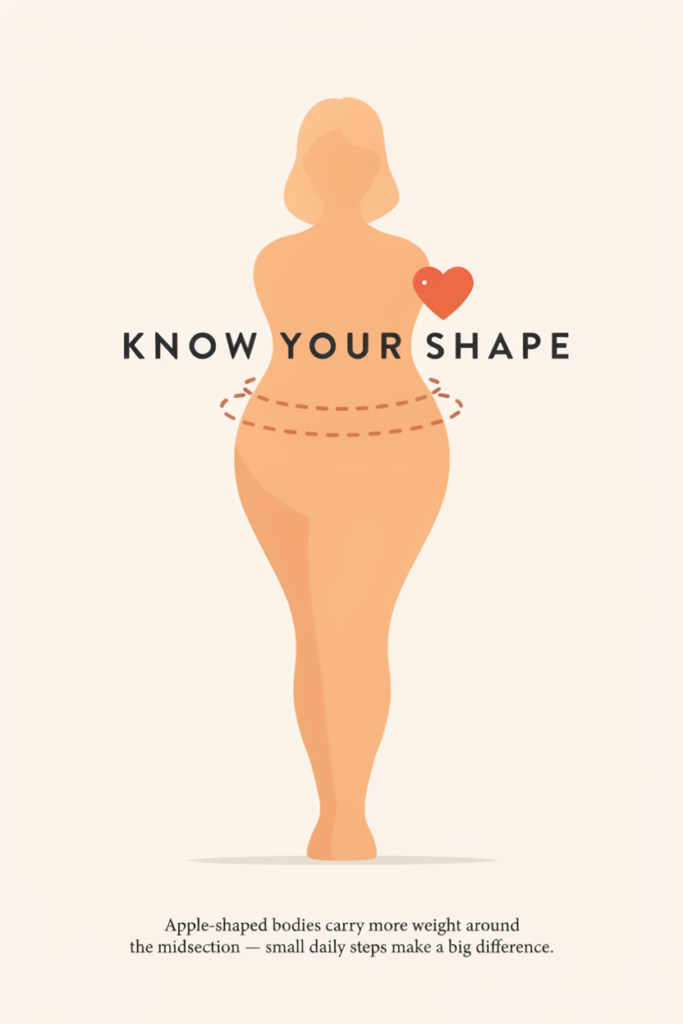
The round body shape — the apple-shaped configuration — classifies when the midsection leads: waist measurement greater than or equal to hips, waist size past 35 inches for women or 40 inches for men, or a body mass index (BMI) of 25 to 30 alongside abdominal obesity (clinically obese at BMI > 30). A waist-to-hip ratio above 0.85 for women (or 0.90 for men — 1.0 marking extreme obesity per WHO) signals serious higher risk: heart attack risk up to threefold, hypertension, coronary heart disease, diabetes, colorectal cancer, cancer, prostate cancer and testicular cancer risk in men, and rising mortality by age 75 — the 34 inches benchmark for women is an early warning below the clinical 35-inch cutoff, where chronic health problems begin before full cardiovascular disease onset. Abdominal fat and visceral fat dominate over peripheral fat, impairing, food composition utilization, cognitive ability, diet adherence, and healthy weight maintenance, compounding heart disease risk over time. A care team-supported individualized plan covering nutrition, exercise, exercise strategies, nutrition strategies, and personalized fitness plans — including an exercise routine of strength exercises, physical activity, and weight-bearing activities targeting fat loss and a healthy waistline, with osteoporosis prevention through bone structure maintenance — is standard for health and fitness and weight management; a nutrient-dense diet reduces visceral fat and supports healthy weight, with belly fat responding best when overall health goals include heart disease prevention. Elongate torso and illusion of defined waist strategies lead fashion styling for the less defined waist and abdominal area profile, creating a balanced appearance where the body shape permits.
Formula: Waist ≥ Hip, OR Waist > 35″ (women) / 40″ (men), WHR > 0.85 (women) / 0.90 (men)
6. Rectangle Body Shape
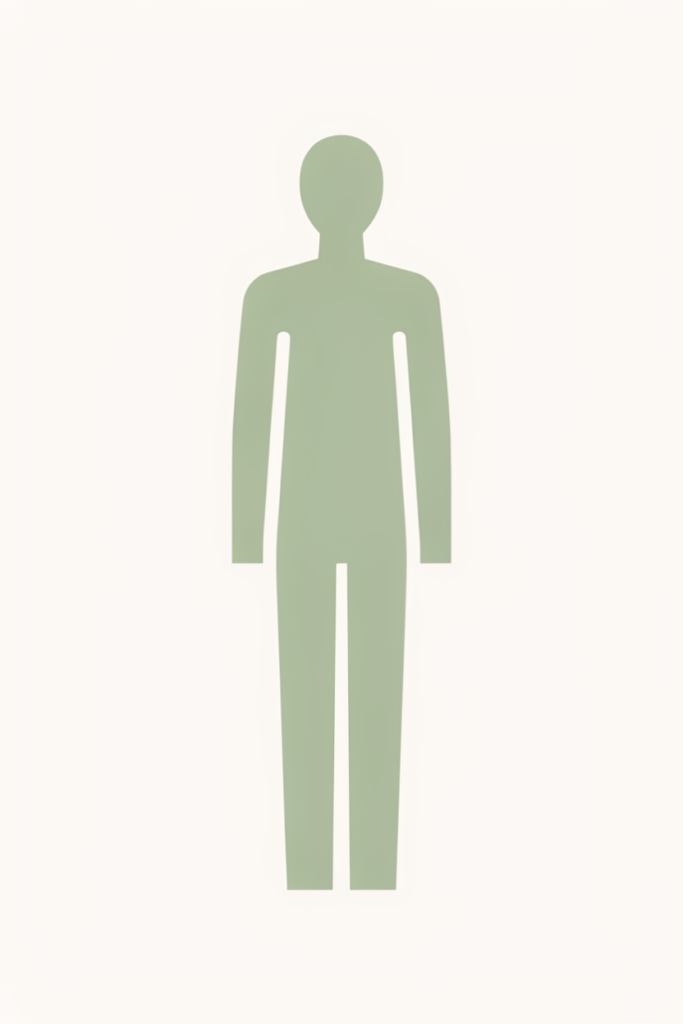
Straight up-and-down describes it in practice: the rectangle body shape registers when bust size, waist size, and hip size all fall within 5% of each other — similar measurements across zones with minimal waist definition and a silhouette of straight lines from shoulders to hips. Beyond the three body types of classical somatotypes — ectomorph, endomorphs, mesomorph — this shape spans them all: the ectomorph arrives through a lean, long build, high metabolism, slight of build profile that’s challenging to build muscle; endomorphs through a difficult to lose fat, hold weight tendency that distributes body fat uniformly; gaining fat and losing fat symmetrically maintains the rectangle body shape regardless of scale reading. Fashion styling breaks straight lines via flared cuts, belted waist, and volume to create illusion of curves, introduce waist definition, and craft the illusion of defined waist through definition — a unique body configuration where normal body shapes expectations invert and bone structure provides no inherent curvature.
Formula: |Bust − Hip| < 5%, |Waist − Hip| < 5%, |Bust − Waist| < 5%
7. Inverted Triangle Body Shape
When shoulder width or bust size exceeds hip size by 5% or more, the inverted triangle emerges — the athletic appearance driven by an athletic build, broad chest, strong frame, and targeted muscle groups: hamstrings, glutes, and shoulders dominating the upper structure against a narrower lower body and streamlined lower half. The mesomorph signature carries high muscle mass, gain weight through muscle groups rather than body fat, and a strong upper structure; the smallest chest-to-hip differential below the waist identifies this quickly, and normal body shapes rarely hit this shoulder-to-hip differential outside athletic training populations. Minimize shoulder bulk, build volume lower body, and balance proportions through definition below — dresses, tops, jeans with flare correct the straighter silhouette at the hip, and clothing recommendations favor lines that direct curves toward the narrower lower body for overall health-informed athletic dressing.
Formula: Bust (or Shoulder Width) > Hip by 5%+, WHR < 0.70, Narrower Lower Body
Why It’s Important to Know Your Body Shape
Most people shop without a clear picture of what actually works for their frame — and that gap shows in every ill-fitting result. Knowing your body shape isn’t about labeling yourself; it’s about understanding proportion on a deeper level. Once you recognize whether you carry subtle curves, hold a more defined waistline, or are working with a rectangular body overall, the logic of dressing shifts entirely. A structured silhouette that adds depth to one frame adds only unwanted bulk to another. Even the shift from a straight cut to an A-line can completely change the balance of a look — and after working with many styling clients over the years, I’ve seen how much dimension that single adjustment creates. It’s not about fashion rules; it’s about understanding the geometry of your own frame.
The value of this self-knowledge extends well beyond formal settings and polished office presentations. Someone who truly understands their shape gravitates naturally toward strategic layering, reaches for pieces that feel elegant and refined, and stops spending money on trends that do nothing for their proportions. A person working with a graceful silhouette — fuller through the hips, narrower through the shoulders — starts to see how layers and sophisticated draping quietly redistribute visual weight where it’s needed most. Someone who recognizes their own flattering angles stops second-guessing every mirror and starts dressing with real intention. That shift, from vague instinct to clear self-awareness, is what makes the whole process feel less like guesswork and more like the most practical, glamorous shortcut to dressing well that anyone can develop.
Waist-Hip Ratio
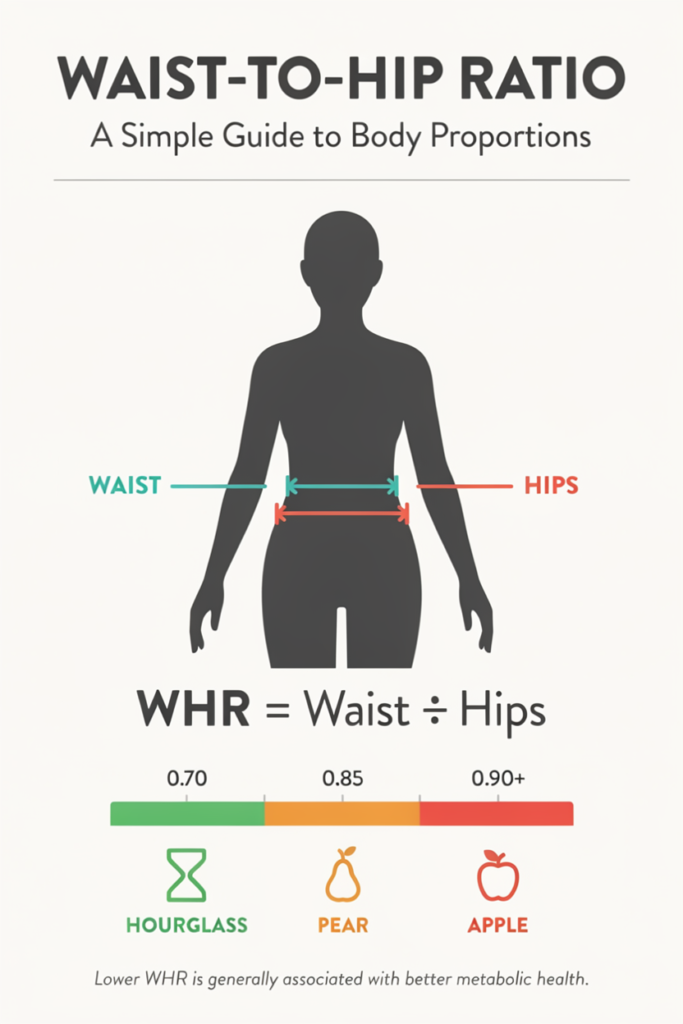
The waist-hip ratio (WHR) works like a coordinate system for your body — a single number derived by dividing waist circumference by hips measurement that reveals more about weight distribution than visual inspection ever could. Women landing near 0.7 typically reflect an hourglass figure, where a narrowing waistline produces the hourglass silhouette that most styling advice quietly assumes as the default template. Push that reading past 0.85, and weight distribution drapes over midsection, signaling an apple pattern where waist attention becomes the strategic priority. The rectangular figure occupies the middle ground — hips and waist measurements nearly matched, creating a balanced yet undefined structure. Pinpointing where you fall isn’t just cosmetic; it anchors every honest clothing strategy and gives you a direct, measurable path to define waist with genuine precision.
Below 0.8 in women, WHR reliably signals a pear distribution where balance hips becomes the central design goal, and redirecting upper body attention compensates for the proportional gap. Men recording above 0.9 often occupy rectangle shape territory, where building visual width into the shoulder zone and reinforcing structure through the torso does most of the visual heavy lifting. For plus size bodies, the ratio remains equally revealing — it clarifies whether you should emphasize shoulders and generate upward attention, or engineer a cinched effect at the center to fully define silhouette. The ratio holds up whether you’re navigating a professional dress code or keeping things casual, because understanding your natural curves — or the measured absence of them — is the only honest foundation for dressing well.
The Most Accurate Free Body Shape Calculator Online
Most tools promising body shape analysis bury results behind account walls and email capture — what makes the most accurate free body shape calculator genuinely useful is that it operates with no sign-up required, surfacing your result immediately. The output isn’t reduced to a text label; a clear visual icon alongside your body shape icon makes the classification intuitive the moment you see it. Having worked through styling decisions with clients across genuinely different proportions, the consistent observation is that accuracy at the identification stage changes everything downstream. A tool that reliably distinguishes someone with a balanced shape from one with a structured shape directs two very different people toward fundamentally different wardrobe outcomes — one toward styles that accentuate waistline definition, the other toward garments engineered to create a curvier silhouette without relying solely on fit.
The real utility of this calculator lies in how it streamlines the distance between raw measurements and actionable styling clarity. Knowing your body type with confidence produces a slimming effect on decision fatigue — fewer purchases that miss the mark, fewer returns, and a sharper instinct for which proportions genuinely suit your shape. For anyone trying to achieve a hourglass effect, establish lower body balance, or simply arrive at a more flattering shape in daily wear, a reliable baseline shifts the entire approach to dressing. The tool also functions as an anchor during necessary focus shift moments — when trend cycles push toward silhouettes that work against your natural proportions, you have the data to hold your ground rather than chase what’s merely seasonal.
Outfits and Style Tips for Every Body Shape
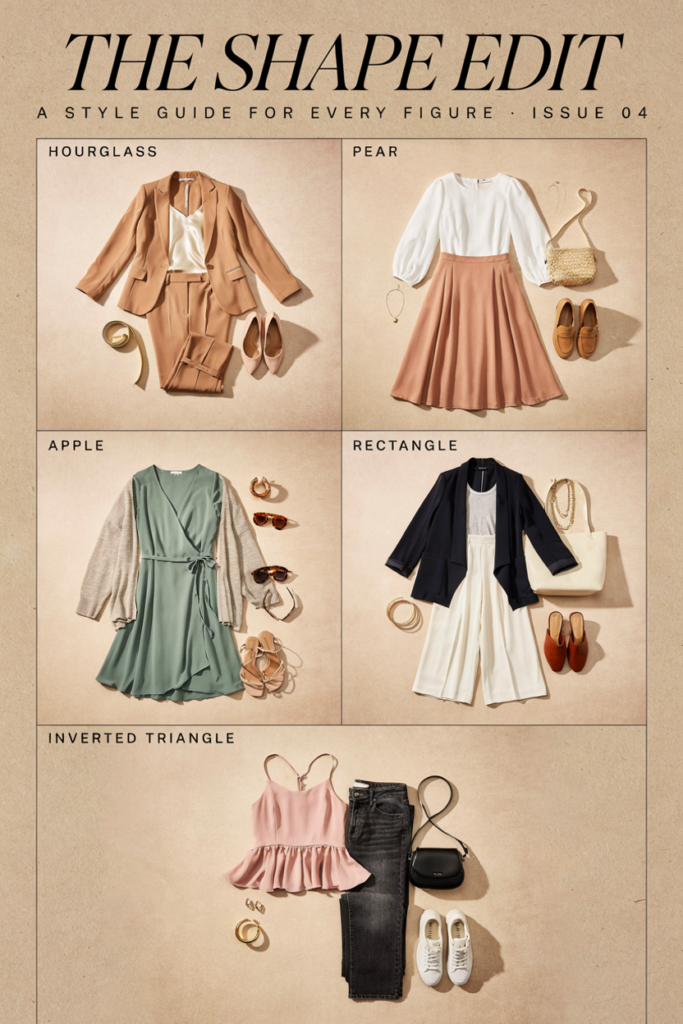
Structured Salwar Suit or Blazer
- A Structured Salwar Suit or Blazer with peplum kurtas works well for professional settings, while a Longline Jacket over a mid-length kurti and Flared Pants adds graceful movement for everyday wear — Peplum Tops with flowing bottoms and Sarees with careful draping round out the wardrobe with comfort and timeless elegance. Now moving on to styling recommendations for rectangle-framed men.
For this body type
- For this body type, layering is key to building silhouette depth — Double-breasted suits with broad lapels or Pinstripe suits with wide ties visually elongate the frame and create longer leg lines, while Slim-fit suits paired with waistcoats and tailored trousers, or Blazers with padded shoulders over Textured suits deliver the dimensional interest formal wear requires. Shoulder padding is essential structural work, not outdated, and skipping it is a common mistake for this frame. Casually, Layered t-shirts under a bomber jacket or a Shirt jacket with chinos and straight-leg jeans naturally broaden the shoulders.
For casual outings
- For casual outings like brunch or shopping, Crop Tops with high-waisted Dhoti Pants and waist belts create soft definition, while Palazzo Pants layered with Kaftan Tops and belts add structured flair and graceful movement without overcomplicating things. For pear-shaped bodies, I’m focusing on drawing attention upward through strategic styling—A-Line Anarkalis and belted Fit-and-Flare Kurtas that accentuate the waist work well for professional settings, while High-Waisted Lehengas with fitted Cholis create balanced proportions for more formal occasions.
Embellished A-Line Lehenga with a fitted choli creates upper body volume while the skirt drapes the hips beautifully, and pairing a Padded Blouse with a saree enhances the bust for pure elegance. A Peplum Anarkali with a cinched waist and statement dupatta brings definition and glamour, while a High-waisted Skirt with an embellished kurta balances the hips — the key across all these celebration looks is emphasizing the waist through strategic cut and drape. For everyday wear, a Cotton A-Line Anarkali Dress offers that same effortless balance.
For relaxed daily dressing,
- For relaxed daily dressing, a Peplum Top with slim-fit leggings or a Layered Kaftan in a loose fit provides comfort, and a Flowy Maxi Dress with a drawstring waist over leggings is the perfect easy-going option. For pear-shaped figures, the strategy is clear: choose A-line skirts with flare from the waist, wear darker colors on the bottom paired with bright embellishments on top, and avoid anything tight-fitting below. Pear-shaped men should lean into fitted tops with flared or straight-leg pants and patterned or colorful tops to draw attention upward.
The hourglass shape
- The hourglass shape calls for pieces that work with its natural proportions rather than fighting them. For professional settings, a Saree with a Belt paired with a fitted blouse that accentuates curves brings polished authority, while a Pencil Skirt with a Peplum Top, a Straight-Cut Kurta with cigarette pants, or Sheath Dresses that follow the body’s natural lines all emphasize curves with understated elegance. A-Line Midi Dresses with subtle flares remain the versatile formal choice that translates across different work environments.
For casual occasions

- For casual occasions like brunches and shopping, Wrap Dresses with a deep V-neckline and adjustable waist tie naturally define the midsection, while Peplum Tops with Jeans or High-Waisted Palazzo Jumpsuits keep things comfortable without sacrificing shape. Fit Tops with flared skirts and fitted tees with denim add variety, while Tunic Tops over leggings and high-waisted joggers with fitted crop tops make everyday dressing effortless and relaxed.
For special occasions
- For special occasions like weddings and parties, hourglass shapes truly shine — a Lehenga with Fitted Choli creates proportional harmony through the flared skirt, Saree Gowns with contemporary finishes hug curves elegantly, and Mermaid Gowns that flare below the knee deliver dramatic impact. Cocktail Dresses with structured bodices and flared bottoms bring polished sophistication, all built on the same principle that this silhouette is inherently flattering and occasion dressing should feel like a celebration.
For plus-size hourglass women
- For plus-size hourglass women, the strategy centers on anchoring the wardrobe with high-waisted bottoms to emphasize the waistline, investing in structured pieces like fitted blazers and tailored dresses that intentionally frame the figure, and leaning on wrap dresses as a reliable, figure-flattering foundation — the key being to reject shapeless or baggy silhouettes that obscure curves rather than showcase them.
Apple-shaped women
- Apple-shaped women dress most effectively through waist-defining, lengthening silhouettes — Wrap Dresses with V-necklines that cinch the waist and elongate the neck, paired with Tailored Blazers over High-Waisted Trousers to create structured lines that extend the legs.
For formal settings
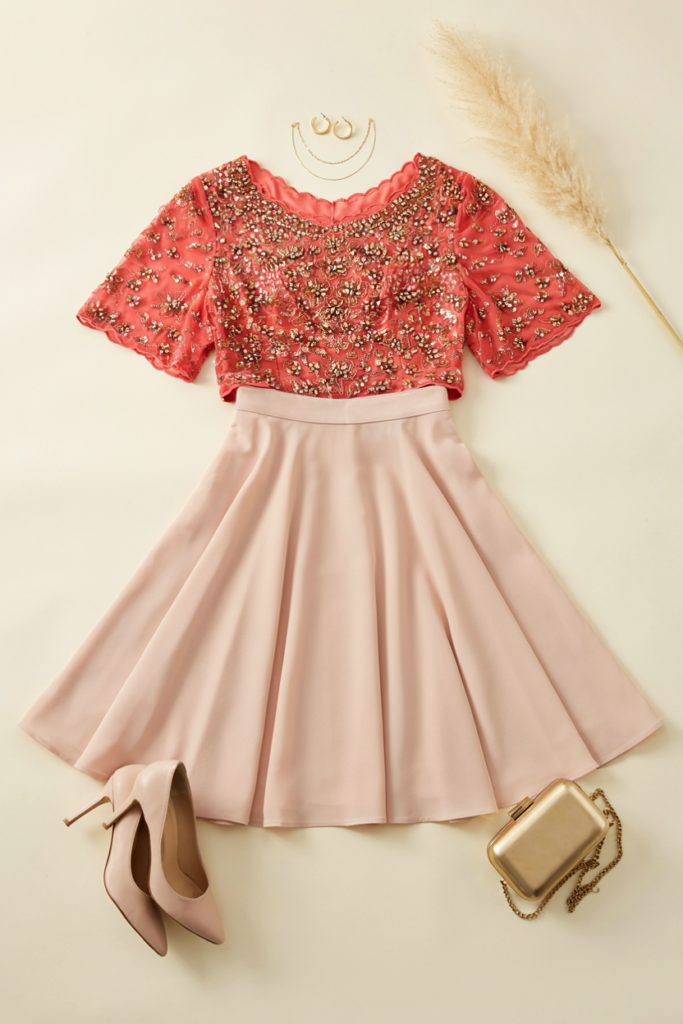
- For formal settings, Peplum Tops with Pencil Skirts, A-line Kurtas paired with Palazzo Pants, and Long Straight-Cut Dresses in flowing fabrics with belts all work as polished professional choices. Casual wear gravitates toward High-Waisted Jeans with fitted tops to highlight the waist, Sweatshirts with Leggings for comfort and trend, Kaftans with Joggers for relaxed movement, Straight-Cut Kurtis with side slits paired with jeans, and Casual Maxi Dresses with defined waists and flowing skirts for everyday versatility.
For celebrations
- For celebrations, Floor-Length Gowns with empire waistlines, Designer Lehengas with Crop Tops, and Silk Sarees with stylish blouses shine at weddings and festive events. For plus-size apple shapes specifically, I’m focusing on V-necks, empire waists, peplum styles, and soft flowing fabrics while avoiding clingy materials, high necklines, and anything that draws attention to problem areas rather than strengths.
Inverted triangle body shape
- Inverted triangle body shape — where broader shoulders and narrower hips require volume at the bottom and visual softening at the top. ens broad chest, or pairing a dark jacket with light trousers where the dark tones slim the upper body and lighter bottoms add width below — these combinations work across any dress code. The key is creating visual equilibrium rather than emphasizing what’s already prominent.
Across all body types
- Across all body types, certain universal principles emerge: peplum tops with belted waists define the midsection, bootcut pants naturally elongate while balancing proportions, and avoiding boxy silhouettes matters because shapeless pieces diminish rather than enhance. Straight-cut tops tucked into high-waisted bottoms work best, and skinny jeans pair effectively with flowing upper pieces when the overall intention is balanced.
Real Takeaway Threading
- The real takeaway threading through everything is that tailored proportion awareness — not chasing trends or hiding — creates genuinely personal style. Every body shape has its own visual language, and dressing well means learning to speak it fluently through intentional choices.
FAQs:
Does a Woman’s Body Shape Change with Age?
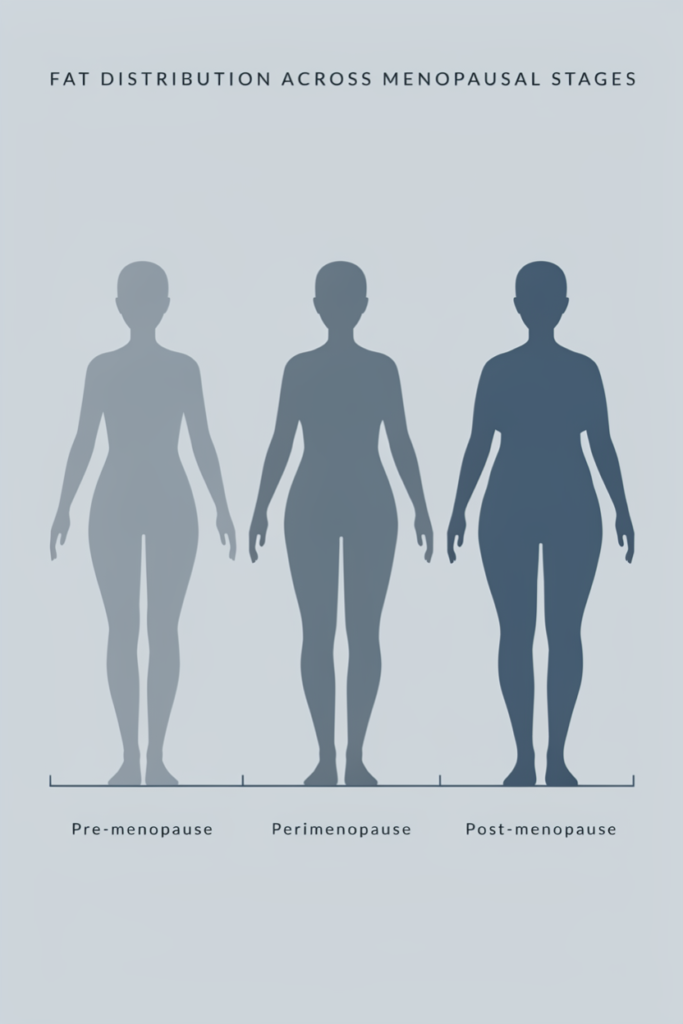
Estrogen quietly governs how the female body tends to store weight in younger years, channeling fat toward the buttocks and thighs to preserve natural fat storage patterns — which is precisely why most female body shapes feature a narrower waist relative to hip or bust. What I’ve observed consistently is that the real shift begins post-menopause: as estrogen declines, fat distribution migrates toward the stomach, waist circumference increases, and the waist-hip ratio climbs into ranges linked to elevated health risk, including obesity and diabetes. This is why a woman’s body shape — and the hip measurements and waist definition that define it — can transform significantly across decades, entirely independent of losing weight or gaining it. The male pattern diverges here; abdominal fat accumulates earlier in men, yet it rarely carries the same degree of hormonal unpredictability. For premenopausal and post-menopausal women, weight distribution is largely governed by hormonal shifts — which means reading proportions through measurements alone misses the most critical variable: age.
Can You Change Your Body Shape?
Your physical build, frame, and metabolism set the foundation of your body’s silhouette — but they don’t permanently define your visual outline. Whether you tend toward an ectomorph, mesomorph, or endomorph body type, strategic efforts to lose weight or develop muscle can meaningfully shift your body’s ratio and alter how you compare proportionally across your shoulders, hip, and midsection. A naturally bottom-heavy form or an oval distribution can evolve noticeably over time, though bone structure — like a trapezoid upper body — stays anatomically fixed. The World Health Organisation recognizes that maintaining a healthy waist size below 35 inches (88 cm) for females and 40 inches (102 cm) for males reduces health risks including asthma and Alzheimer’s, proving that body change carries real clinical stakes. Treat your most likely body shape as a starting point — your lean, athletic composition and high metabolism or tendency to hold weight are traits to work with, not walls to work against.
What Are the 3 Main Body Types?
Most people encounter the three primary somatotypes in fitness circles, yet experienced practitioners know this metabolic body type framework is far richer than a simple scale allows. The ectomorph frame runs long and naturally lean — individuals here find it challenging to build muscle no matter how consistently they train. Mesomorphs occupy the middle ground, building strength with relative ease. Endomorphs carry a fuller, denser build, and often find it difficult to lose fat even with careful effort. These body types aren’t gender-restricted — both genders express all three classifications, and male body shapes are catalogued just as precisely under this system as female ones. Since most people blend characteristics from multiple categories, any personal classification remains estimated — a useful starting point, not a fixed identity.
What Is My Body Shape?
Body shape isn’t about weight or clothing labels — it’s about proportion, and that’s precisely what a measurement-based method reveals. In practice, a soft tape measure and just four measurements — the fullest part of chest, narrowest part of torso, fullest part of hips, and the often-dismissed high hip measurement — can distinguish one silhouette from another far more reliably than BMI or body mass index, which only reads height and ignores how the body actually distributes mass. Among the 5 female body types, from frames where shoulders and bust wider than the hips to a classic narrow waist flanked by equal halves, or hips wider than bust anchoring the lower frame, a free tool built on consistent proportion rules will return accurate results that no mirror assessment ever can.
What Is a Body Shape Calculator?
A body shape calculator is a free tool built to analyze body shapes — helping men and women instantly understand their silhouette by asking them to select gender and enter three measurements into each input field: the fullest point of chest, natural waist, and widest point below waist. Rather than delivering a definitive label, it operates as a helpful guide, using accurate proportional ratios to differentiate between the five core categories — hourglass figure, ruler body, triangle, inverted triangles, and spoons — each specifically proportioned in its own way. Most basic calculators factor in hip and bust measurements and the narrowest point of relaxed torso, with some including an optional shoulder measurement for enhanced accuracy. Consistency matters here: always measure in the same unit, whether inches or centimeters, matching your preferred unit to either the imperial or metric system, since mixing units yields an incorrect result — the tool ultimately estimates rather than diagnoses, making it a grounded starting point for women’s body measurement awareness and personal style clarity.
How Do I Find Out What Body Shape I Am?
Standing with feet together is where most practitioners start — it stabilizes posture before you take waist measurements and compare them against the high hip, which sits roughly 3-4 inches above the fullest point. A reliable 3-measurement calculator accounts for the hip curve or hip shelf that separates a straight body from a defined silhouette, and once you note whether hips larger than bust differ by nine inches or stay within two or more inches, your common body shape becomes readable. How weight distributes across the bottom half versus the upper body is equally telling — slim arms and long legs with shelf-like hips signal one archetype, while a frame that is not curvy signals another entirely. Gender informs interpretation too: the female population has historically used the 36-24-36 figure as a standard measurement reference, but that benchmark is just one entry point, not the full picture.
What Measurements Do I Need for a Body Shape Calculator?
Most body shape calculators need exactly 4 inputs, but people rarely talk about how those numbers came to carry such weight. The basics — bust, waist, and hips, with the hip reading taken 3-4 inches below waist level — seem straightforward until you realize how deeply they’re tangled in sizing history. For a woman, these three figures once rigidly defined the 90-60-90 figure and its metric twin, 90-71.5-90 cm, while for a man, waist circumference alone became the clinical shorthand for metabolic risk — cross 37 inches (94 cm) and most health standards flag you as obese. The confusion around women’s clothing size and US clothing sizes traces back to 1958,
When standardization cracked open the door to vanity sizing, which is why a size zero or size 0 today bears little resemblance to the original 30-22-32 inches (76-56-81 cm) it once described, and why 36-28-36 inches no longer reliably points to a size 8. From a health standpoint, a woman’s waist should ideally stay under 31.5 inches (80 cm), and a waist-to-hip ratio of 0.9 or 0.85 tells you more about visceral fat risk than any clothing label ever could. If your measurements suggest you’re underweight or far outside typical ranges — including those associated with a zero figure — a doctor consultation is the first, non-negotiable step. And once your numbers are in, the distribution becomes interesting: roughly 46% of people land in the most common shape category, 20% in the second, 14% in the third, and only 8% in the least common — proportions that only mean something when your measurements are accurate.
What body shape is most common?
From what I’ve seen working with hundreds of women across different age groups, the rectangle body shape tends to be the most common — where the shoulders, waist, and hips sit at roughly similar measurements without a dramatic curve difference. That said, the pear shape runs a close second, especially among women in their 30s and beyond as hips naturally widen. Genetics, hormones, and even ethnicity play a role in how fat distributes across the body, so there’s genuinely no single “dominant” shape worldwide. What matters more than frequency is understanding your own proportions so you can dress, train, or eat in a way that supports your personal goals.
What is the difference between body shape and body type?
These two terms get mixed up constantly, and honestly, even fitness professionals blur the line. Body shape refers to your external silhouette — the visual outline formed by your shoulders, bust, waist, and hips — while body type (often called somatotype) describes your underlying physiological build: ectomorph, mesomorph, or endomorph. Think of body shape as what you see in the mirror and body type as how your body tends to respond to food and exercise. Someone can have a pear-shaped silhouette while being an endomorph, or an hourglass shape while being a natural ectomorph. Knowing both gives you a much more complete picture of how your body actually works.
Can men use this body shape calculator?
Yes, men can absolutely use a body shape calculator, though most are built around female proportions and use measurements like bust, waist, and hips as reference points. For men, the relevant measurements shift — shoulders, chest, waist, and sometimes hips are more meaningful markers. Male body shapes are typically described as rectangle, triangle (or “carrot”), oval, or trapezoid. I’d recommend men use a calculator specifically designed for male proportions to get more accurate and actionable results, rather than forcing their numbers into a female-focused framework that won’t reflect their actual build.
Can I use centimeters instead of inches?
Absolutely — centimeters work just as well as inches in any body shape calculator, as long as you stay consistent and use the same unit for every measurement. The calculator compares ratios between your bust, waist, and hips, so the unit itself doesn’t change the outcome. Where people run into trouble is mixing units — measuring their waist in inches and their hips in centimeters, for example — which throws off the entire calculation. Just pick one and stick with it throughout. Most online calculators either accept both or let you toggle between them before you start.
How accurate is this body shape calculator?
A body shape calculator is a useful starting point, not a medical assessment. Its accuracy depends entirely on how precisely you take your measurements — and in my experience, most people measure too loosely, especially around the waist. Done correctly with a flexible tape measure held snug (not tight) against the skin, the results are reasonably reliable for identifying your general shape category. That said, these calculators don’t account for muscle mass, bone structure, or fat distribution patterns, all of which can meaningfully affect how your body actually looks. Treat the result as a guide, not a definitive label.
What is a high hip measurement and why does it matter?
The high hip is measured around the fullest part of your hip area just below the hip bone — typically about 3 to 4 inches below your natural waist — rather than at the very widest point of the hips. It matters because it captures the curve that begins just above the full hip, which is especially relevant for women with a more pronounced pelvic flare or those who carry more volume in the upper hip region. When shopping for bottoms or fitted clothing, the high hip measurement can be the difference between a garment fitting or gaping. I always recommend taking both the high hip and full hip measurements, because that gap between the two tells you a lot about the shape of your lower torso.
What are the 5 female body types?
The five most widely recognized female body shapes are hourglass, pear (also called triangle), apple (inverted triangle or round), rectangle (sometimes called banana), and the inverted triangle. The hourglass has balanced shoulders and hips with a noticeably narrower waist. The pear carries more width through the hips and thighs than the upper body. The apple holds more weight around the midsection with slimmer legs. The rectangle has a fairly even shoulder-waist-hip measurement with minimal waist definition. The inverted triangle has broader shoulders relative to the hips. Some frameworks add a sixth — the oval or diamond — but most classification systems stick with these five as the core categories.
What is the meaning of 36-24-36 figure?
The 36-24-36 figure refers to measurements of 36 inches at the bust, 24 inches at the waist, and 36 inches at the hips — a proportion that has long been held up in Western pop culture as the “ideal” hourglass shape. The numbers reflect a 12-inch difference between the waist and both the bust and hips, which creates that classic curved silhouette. In reality, very few people naturally hold these exact proportions, and the standard itself is largely a product of mid-20th century beauty ideals rather than any medical or health benchmark. It’s worth understanding the measurement as a historical reference point rather than a personal target — genuine health and proportion look different on every body.
What is a healthy waist size?
According to general health guidelines, a waist circumference below 35 inches (88 cm) for women and below 40 inches (102 cm) for men is considered within a lower-risk range for cardiovascular and metabolic conditions. Waist size matters because abdominal fat — particularly visceral fat that wraps around internal organs — is more closely linked to health risks than overall body weight. In practice, I’ve seen people with “normal” BMIs carry significant visceral fat and vice versa, which is why waist measurement is often a more telling marker than the scale alone. That said, healthy ranges can also vary slightly by ethnicity, age, and individual health history, so it’s worth discussing your specific numbers with a doctor.
What is a zero figure?
A zero figure refers to a body so slight in its measurements that it corresponds to a US clothing size zero — typically around a 30–32 inch bust, 22–24 inch waist, and 32–34 inch hips, though sizing varies by brand. The term became widespread in fashion industry conversations around the early 2000s when concerns grew about dangerously thin runway standards. From a health standpoint, a size zero is not inherently problematic — some people are naturally slim with these proportions — but the cultural pressure to achieve this silhouette through restriction or extreme dieting is where real harm enters the picture. It’s a clothing size, not a body goal, and it’s worth separating the two completely.
Abdul Rehman
Body Shape Specialist · Fashion Stylist · Health Writer
Abdul Rehman is a body shape specialist and certified fitness consultant with over 7 years of experience helping women and men understand their proportions. He has worked with hundreds of clients across diverse body types — developing a measurement-based approach rooted in WHO and NIDDK research. His expertise bridges body shape analysis, evidence-backed health guidance, and practical fashion styling.